Buying Vacant Land in Putnam County, Florida: What We Actually Check Before We Buy
Putnam County has a lot of inexpensive vacant land.
That's part of what makes it interesting.
It's also part of why we don't buy a parcel just because the price looks cheap.
We've looked at enough Florida dirt to know that the $5,000 lot and the $10,000 lot aren't necessarily the same deal with different price tags. Neither lot is bad, it depends on what you are looking for, BUT we want to make sure that we help you find the land that YOU actually want.
Roads matter, Zoning matters, ownership matters, and utilities matters.
some of Putnam's subdivisions were platted long enough ago that we want to know what today's rules say, not what somebody assumed when the lot was created.
For a broader overview of the area first, you can read our Putnam County Guides below:
For the nuts and bolts of what we look at before buying, keep going.
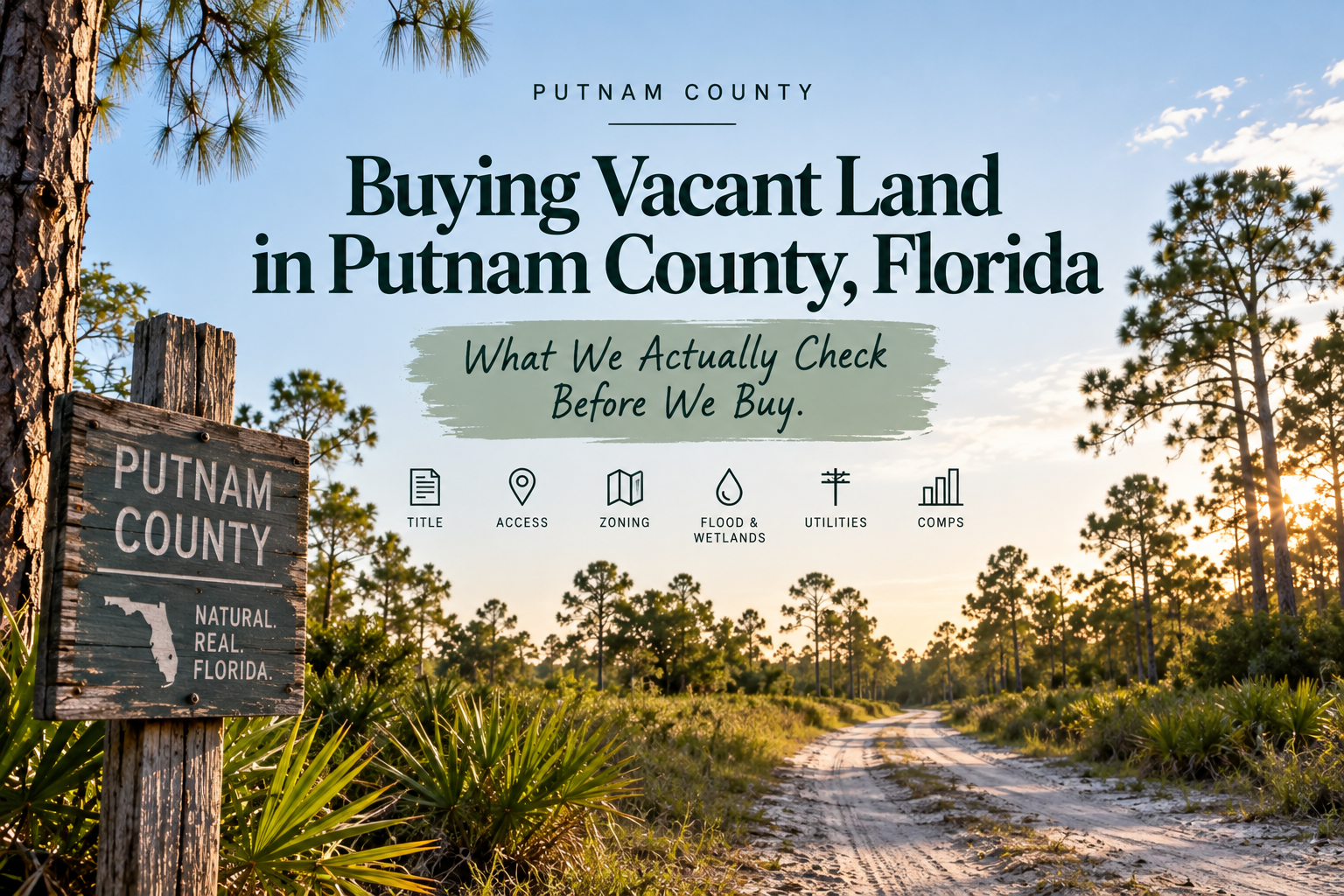
Ownership and title
We usually start with the Putnam County Property Appraiser.
That helps us identify the parcel and owner of record.
Then we go to the Putnam County Clerk's Official Records.
That's where the deeper paper trail lives: deeds, mortgages, liens, judgments, probate records, satisfactions, plats and other recorded documents.
We want to understand how the current owner got the property and whether anything unusual appears in the chain.
A tax deed, probate transfer, old mortgage or weird legal description isn't automatically a deal killer.
It is a reason to keep digging.
Legal description
The parcel number helps us find the property.
The legal description tells us what the recorded document actually conveys.
For lots in places around Interlachen, that may mean comparing the deed to the recorded subdivision plat.
We pay attention to the subdivision, lot and block information instead of assuming the county GIS outline is the final legal boundary.
County mapping is extremely useful.
It is not a survey.
Access
Putnam is where the difference between a road on the map and a road you want to drive down after three days of rain becomes pretty easy to understand.
We check the plat, aerials and available road information.
We also care about whether the parcel has a legal route to a public road.
That does not mean every old platted lot in Putnam has a beautiful county-maintained road sitting in front of it.
Far from it.
For the exact parcel, we verify.
Zoning and intended use
This one matters a lot around Interlachen because R-1 and R-2 are not the same thing.
Putnam's R-1 family of districts and its R-2 family do not offer identical housing options.
So when somebody tells us, “mobile homes are allowed in Putnam County,” our next question is:
On which parcel?
Countywide generalizations are where bad listings come from.
The same goes for RV use.
Putnam has specific temporary-use rules. Temporary use is not the same thing as permanent RV living.
Flood and wetlands
We screen both.
They're different.
For flood hazard information, we use current FEMA mapping.
For wetlands, online maps are useful for screening but aren't the same thing as a formal parcel-specific determination.
Tiny lots make environmental issues especially important because losing part of a small parcel to setbacks, drainage or wetlands can change the practical use of the whole thing.
Utilities
We don't see a power line and automatically write “utilities available.”
For many unincorporated Putnam parcels, private well and septic are common.
But that still does not mean every lot automatically qualifies for a well and septic system.
If septic feasibility is important to a purchase, we want parcel-specific information.
For electricity, we identify the serving utility and check the particular location rather than guessing from nearby homes.
If wells and septic are new territory for you, read Why Many Florida Vacant Lots Require a Well and Septic System.
Putnam-specific red flags we pay attention to
One is tiny old platted lots.
Another is road/access quality.
Another is assuming R-1 and R-2 have the same housing options.
We also watch for tax deeds or other unusual title history, questionable wet areas, parcels where maps and legal descriptions need a closer look, and situations where an inexpensive lot may not satisfy the buyer's intended development plan.
When something isn't clear from our own research, Putnam County also has a formal Lot Inquiry process through Planning & Development Services.
We like that.
Because sometimes the best due-diligence tool is just asking the people who administer the code.
What if you want to finance the lot?
Don't let the monthly payment become the whole decision.
A great financing plan on the wrong parcel is still the wrong parcel.
Owner financing explained
Cheap land should still make sense
We like Putnam County.
There are plenty of interesting little parcels there, and the entry price can make land ownership possible for buyers who aren't shopping for a $400,000 house.
But affordability is not an excuse to stop checking things.
Before we buy, we want the ownership and title story to make sense.
We want the legal description to make sense.
We want access we understand.
We want current zoning that fits the intended use.
We want to know what the flood and wetland screening shows.
We want a realistic utility plan.
And we want the price to make sense against actual sold land.
Basically, we want to know what we're buying before we buy it.