Why Does Florida Have So Many Random Empty Lots?
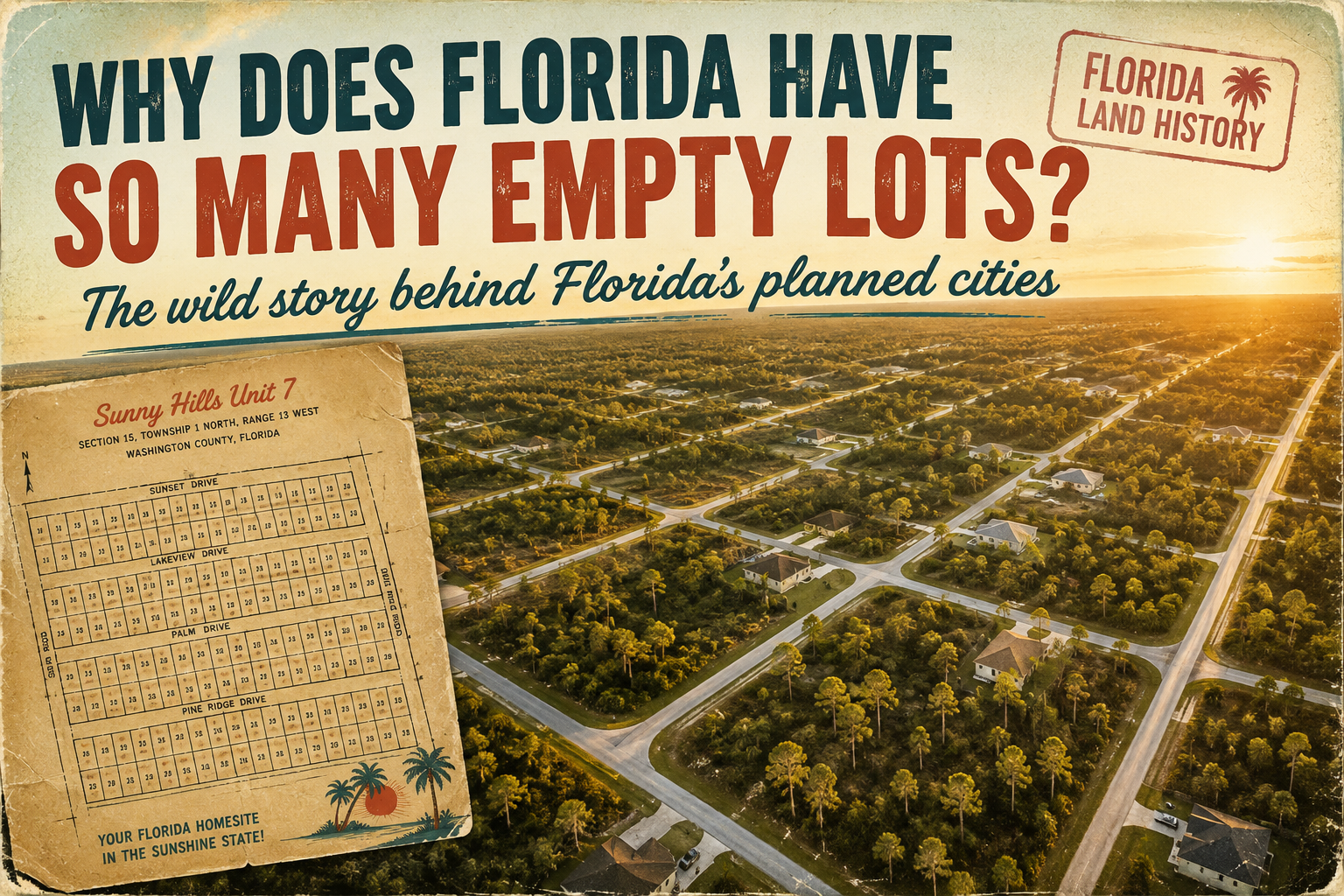
The strange story of the Mackle Brothers, Deltona Corporation, mail-order land, and the enormous Florida cities that were planned long before all the houses showed up.
You’re driving through Florida.
There’s a house.
Then a vacant lot.
Then another house.
Then three wooded lots.
Then a perfectly good road leading past… basically nothing.
And somewhere along the way, you think:
Why are there so many random empty lots here?
That question has a much weirder answer than you might expect.
Because many of those lots are not random at all.
They were planned.
Measured.
Platted.
Numbered.
Advertised.
And, in many cases, sold decades ago as part of enormous master-planned Florida communities.
To understand why, we need to go back to the 1950s and meet three brothers who looked at huge stretches of undeveloped Florida and thought:
You know what this needs? A city.
Meet the Mackle Brothers
Elliott, Robert, and Frank Mackle Jr. were Florida developers with a very big idea.
They realized one main thing. Americans loved Florida.
More specifically, Americans living through northern winters loved the idea of Florida.
Sunshine.
Palm trees.
Retirement.
Fishing.
A little house somewhere warm.
The Mackles figured out that they did not have to wait for all of those people to physically move south before selling them property.
They could sell them the future.
No Zillow.
No Google Maps.
No satellite view.
Just an ad, a map, a dream, and a coupon.
And it worked.
Really, really well.
Port Charlotte Started as Something Much Smaller
The land that would become Port Charlotte was originally envisioned more like a traditional housing project.
Then the Mackles discovered something important:
People were willing to buy the homesites themselves, even if they were not ready to build yet.
That changed everything.
Just think about that for a second.
Two hundred thousand home sites.
Not homes.
Home sites.
Little individually sellable pieces of future Florida.
And the plan kept getting bigger.
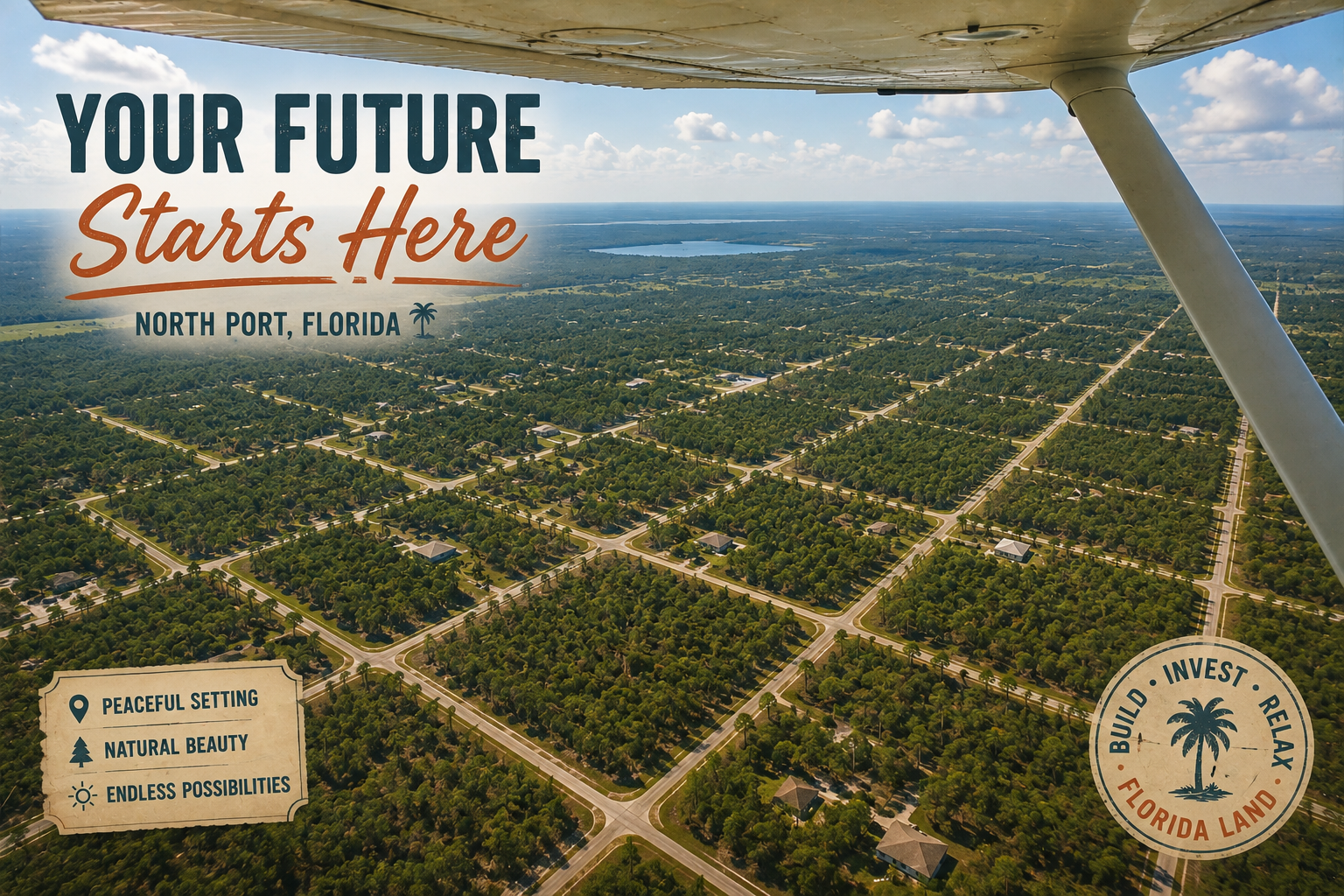
So when you drive through North Port today and see:
house
vacant lot
new construction
vacant lot
house
woods
another house
…you are looking at part of a development story that started generations ago.
But How Do You Sell 200,000 Lots?
This is where things get especially Florida.
You build a marketing machine.
The Mackles did not just put up a sign at the entrance and wait.
They advertised nationally.
They mailed brochures.
They created branch offices.
They built franchise sales networks.
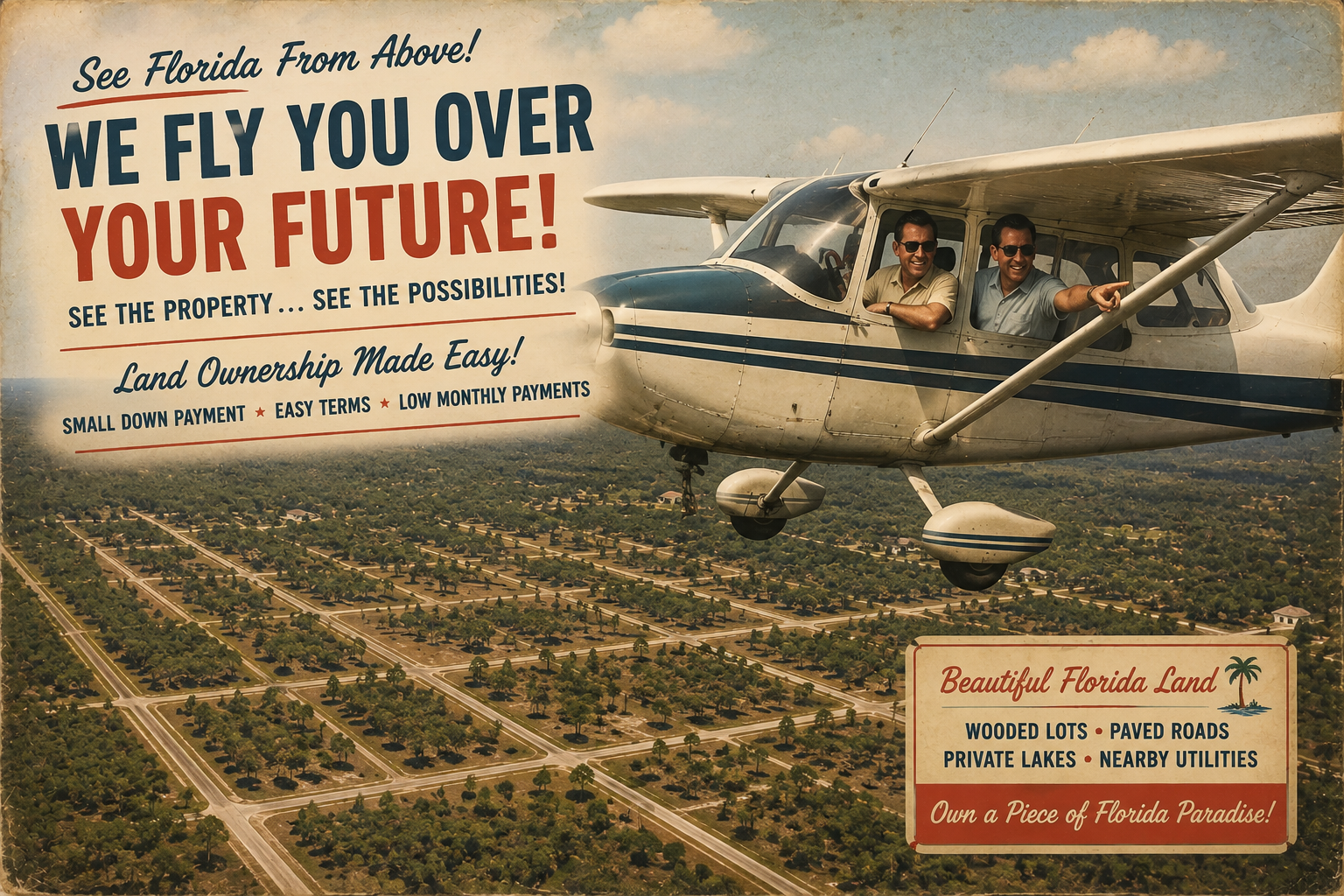
They even flew people over the area in private planes.
They used maps, sunshine, beaches, golf, palm trees, and the promise of retirement to turn undeveloped land into something emotionally real.
The old ads were wonderfully dramatic.
Big headlines.
Tiny monthly payments.
Florida maps.
Palm trees everywhere.
Mail-in coupons.
The visual language was basically:
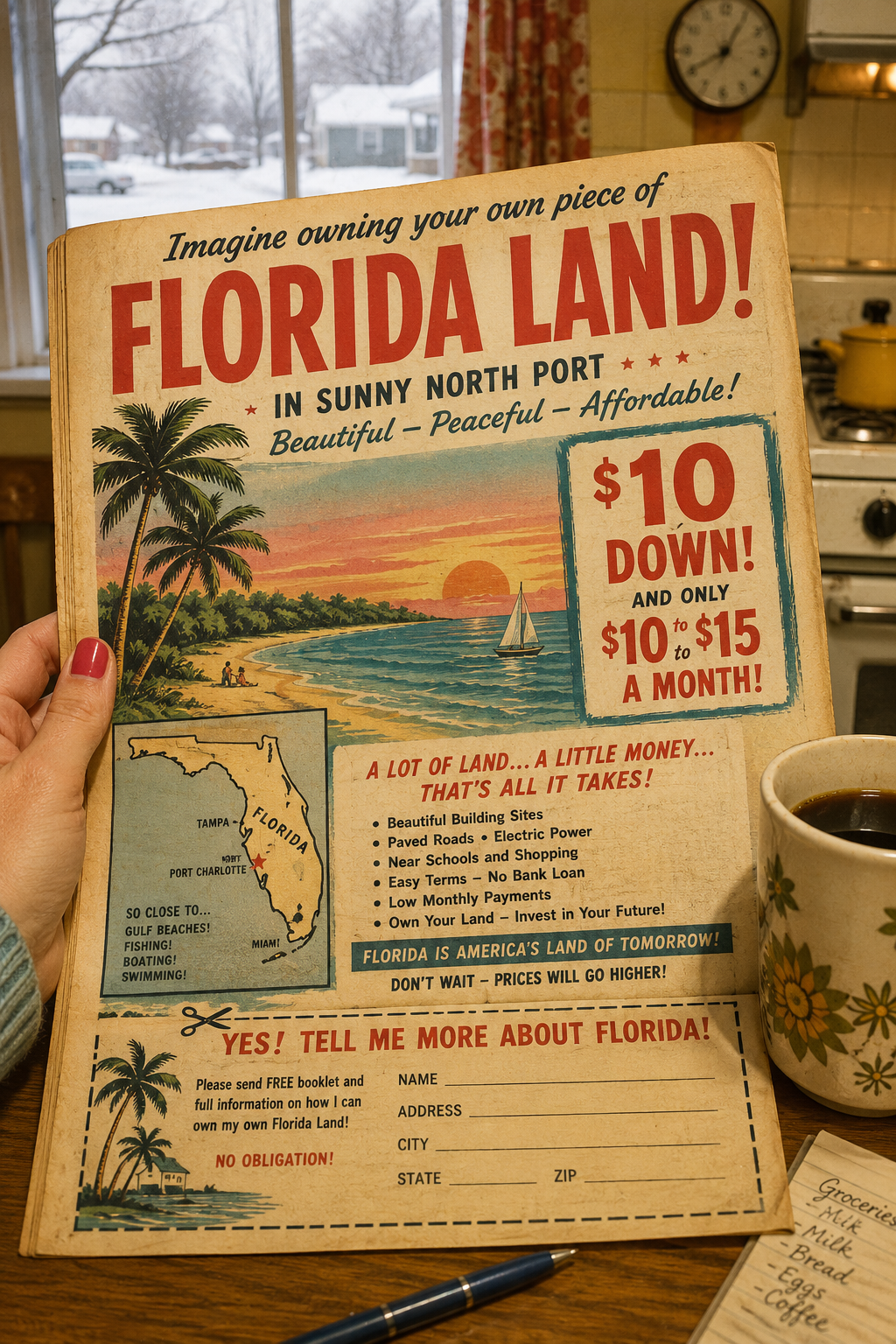
Our research into 1960s and 1970s Florida land advertising found exactly that pattern: oversized affordability headlines, tropical imagery, development maps, and detachable response coupons were common ways to make distant Florida property feel easy and exciting to buy.
It was less like modern real-estate marketing and more like ordering your future life from the back of a magazine.
And Then the Mackles Basically Said, “Let’s Do It Again”
Eventually, the Mackle Brothers left General Development Corporation.
A normal person might have thought:
Well, that was enough enormous city-building for one lifetime.
The Mackles did not.
They formed a new venture that became The Deltona Corporation.
And in 1962, they bought 17,203 acres in southwest Volusia County.
Their plan called for:
35,143 lots.
They named the community Deltona.
Thirty-five thousand lots.
Again: not thirty-five thousand houses.
Thirty-five thousand individual pieces of land.
Apparently they had not yet run out of rectangles.
Deltona Wasn't a Tiny Experiment
Construction started almost immediately.
The first residents arrived in 1963.
By the end of that year, the community had just 180 residents.
Then things started moving.
The 1970 Census counted 4,868 people.
By 1980, Deltona had grown to 15,710 residents.
What began largely as a retirement-oriented community eventually became a major residential area serving people working around the Orlando region.
That is an important part of this story.
These developments were not simply elaborate plans that disappeared.
Many became very real cities.
They just did not fill in all at once.
And Deltona Corporation Kept Going
Deltona was not the only community the company developed.
During the Mackle era, The Deltona Corporation was involved in communities including:
Deltona Lakes
Spring Hill
Marco Island and Marco Shores
Citrus Springs
Marion Oaks
Pine Ridge
Sunny Hills
St. Augustine Shores
Seminole Woods
Tampa Palms
The Mackle Company says a typical Deltona project involved around 15,000 acres, and that the company's international sales network eventually included more than 100 company-owned and franchised offices.
This was not three guys selling a few cheap lots from a folding table.
They Were Exporting the Florida Dream
One of the more fascinating parts of the Mackle story is how sophisticated the sales operation became.
The company created branch and franchise offices around the United States and later in foreign markets.
Salespeople were trained specifically to sell Florida property.
The company maintained a department devoted to controlling and allocating huge inventories of lots.
According to the Mackle Company's history, sales offices could compete for desirable properties, and lots might be placed on short holds while representatives tried to close buyers. Certain promotions and upcoming price increases could create a frenzy among sales offices trying to secure the best inventory.
Which is hilarious when you think about it in modern terms.
Imagine 100 offices calling headquarters because everybody wants the “good lots near the golf course.”
It was basically a 1960s real-estate version of live auctions.
So Why Are So Many Lots Still Empty?
Here is the important part.
Platting land and building homes are two completely different things.
A developer could lay out thousands of individual lots relatively quickly.
But filling all of them with houses could take decades.
And once those lots were sold, every owner had their own plans.
One buyer might build immediately.
Another might hold the property for retirement.
Another might resell it.
Another could pass it down to children.
Another might simply keep paying the taxes and never touch it.
Multiply that by tens of thousands of parcels.
Then wait 50 or 60 years
Unfortunately, this has shaped many of the same problems that we have in Florida today. Developers dont want a few lots in a neighborhood, they want THE neighborhood.
Now you have the Florida landscape we recognize today:
🏡 house
🌲 vacant lot
🏡 house
🌲 vacant lot
🚧 new construction
🌲 two more vacant lots
The subdivision itself can be old even when the neighborhood looks half-finished.
The Roads Can Be Older Than the Houses
This is one of the parts people find strangest.
Sometimes you see an established road network with surprisingly little development along it.
That can happen because the infrastructure and subdivision pattern came first.
The whole point of these master-planned projects was to create a future community.
Roads, lot lines, sections, and neighborhoods could exist well before every individual buyer was ready to build.
So when a road seems to lead into nowhere, it may not have been built for nowhere.
It may have been built for a version of the neighborhood that planners expected to appear over many years.
And in many Florida communities, that filling-in process is still happening.
North Port Is One of the Best Places to See It
North Port is especially fascinating because you can watch several eras of Florida development sitting next to each other.
On the same drive, you might see:
older homes
brand-new construction
untouched wooded lots
cleared homesites
paved residential streets
newer commercial development
an entire platted subdivision with no movement
The city traces directly back to General Development's giant Port Charlotte holdings, with the Sarasota County portion eventually becoming North Port.
Today, North Port is a real, growing city.
But its huge supply of platted residential lots means that some parts of the city still show that original development pattern very clearly.
We actually love this about the area.
It makes the city feel a little like a time-lapse happening in real life.
Read next: Why North Port Still Feels Like Old Florida
Sunny Hills Has a Similar Story
The same development model helps explain places like Sunny Hills in Washington County.
Sunny Hills became another Deltona Corporation community, and today it still contains a large supply of residential lots.
That does not mean the area “failed.”
It means the land was divided and sold at a scale far larger than the number of homes that could reasonably be built all at once.
Some sections developed faster.
Some slower.
Some lots changed owners multiple times before anyone ever built anything on them.
That is why understanding the history of these Florida subdivisions can completely change the way you look at vacant land.
A wooded lot may look untouched.
Legally and historically, it might have been somebody's numbered homesite since the Beatles were still together.
Were All Those Old Florida Land Deals Great Deals?
Definitely not.
This is where nostalgia needs a reality check.
Florida's land-sales history includes some spectacular marketing, but it also includes overpromising, speculation, pushy salesmen, fishy sales tactics, and the reality is that there were buyers who did not always understand exactly what they were purchasing.
That is one reason modern due diligence matters so much.
The old brochure might have told you about:
🌴 sunshine
⛳ golf
🌊 nearby water
🏡 your future home
Today, we would also tell you to ask:
What is the zoning?
Does the property have legal access?
Is it in a flood zone?
Are wetlands present?
What utilities are available?
Will you need well and septic?
Can you actually build what you want?
That part is much less glamorous.
It is also much more important.
Florida zoning guide:
https://www.paradiseparcels.com/the-dirt/-the-5-minute-guide-to-zoning-what-you-can-and-cant-do-on-your-florida-land
Flood zones & wetlands guide:
https://www.paradiseparcels.com/the-dirt/flood-zones-and-wetlands-in-florida-what-land-buyers-need-to-know-before-purchasing
The Weirdest Part?
The basic idea still works.
Not the giant mail-order city machine.
Not the newspaper coupon.
But the emotional part.
People still look at an empty Florida lot and imagine something that is not there yet.
A house.
A garden.
A retirement spot.
An investment.
A place they can say is theirs.
That is exactly what those old developers were selling.
They were selling land, sure.
But mostly they were selling possibility.
And maybe that is why these random empty lots are still so interesting.
They are little leftovers from somebody's vision of future Florida.
Some of that future already arrived.
Some of it is still waiting.
Some of it is waiting for its next adventure.
So the Next Time You See a Random Empty Lot...
Look at it a little differently.
That little rectangle between two houses may have been drawn onto a subdivision map 60 years ago.
Someone may have bought it from a brochure.
Someone may have planned to retire there.
Someone else may have inherited it.
And now another generation is deciding what happens next.
Florida's empty lots are not always signs that nothing happened.
Sometimes they are evidence that a very big plan happened a very long time ago.
And honestly?
That's a lot more interesting than “just dirt.”
FAQ: Why Florida Has So Many Vacant Lots
Why are there so many vacant residential lots in Florida?
Many Florida communities were platted on a massive scale during the mid-20th century. Developers divided enormous tracts into individual homesites and sold them over time, often before homes were built. That created a long-term mix of developed and undeveloped lots.
Who were the Mackle Brothers?
Elliott, Robert, and Frank Mackle Jr. were prominent Florida developers associated with General Development Corporation and later The Deltona Corporation. Their companies helped create large planned communities including Port Charlotte, North Port, Deltona, Spring Hill, Sunny Hills, and others.
Did people really buy Florida land through the mail?
Yes. National advertising and installment sales were important parts of the Florida land business during this era. Historical ads commonly used maps, tropical imagery, low down-payment offers, and mail-in response coupons.
Why would somebody buy a lot and never build on it?
Buyers may have purchased for future retirement, investment, family use, or simply to hold the property. Plans change, and lots can also be inherited or resold many times before development occurs.
Does an old platted lot automatically mean it is buildable today?
No. Buyers should still verify current zoning, access, flood risk, wetlands, setbacks, utility requirements, and other development rules before purchasing.