Florida Sold a Dream for $10 Down: The Wild History of Buying Land in the Sunshine State
Before Zillow. Before Google Maps. Before you could pull up a parcel from your phone, thousands of Americans bought Florida land from newspaper ads, glossy brochures—and sometimes without ever seeing the property in person.
Picture this.
It’s the 1960s.
You’re sitting at your kitchen table somewhere in New York, Ohio, Pennsylvania, or Michigan. Outside, it’s freezing.
You open a newspaper or magazine and there it is:
FLORIDA LAND.
Palm trees. Blue water. Sunshine.
And, in enormous letters, a payment so small it almost sounds made up.
$10 DOWN.
Maybe another $10 or $15 a month.
There’s no satellite imagery to study. No Street View. No county property appraiser website to pull up. You certainly can’t drop a pin into your phone and see exactly how far the property is from the Gulf.
Instead, there might be a little map of Florida, an aerial photo, a subdivision plat.. AND a coupon.
You fill it out.
You mail it back.
And just like that, you could be on your way to owning your own little piece of Florida.
It sounds almost unbelievable now.
But this was a very real chapter of Florida history.
And if you've ever driven through places like North Port or Port Charlotte and wondered why there are roads, neighborhoods and thousands of seemingly random vacant lots mixed between houses...
part of the answer starts here.
Florida Wasn't Just Selling Land. It Was Selling Florida.
The genius of those old advertisements wasn't really the property.
It was the idea behind it.
Florida represented something.
Warm winters.
Palm trees.
Retirement.
Fishing.
A slower life.
A place where maybe—someday—you'd build a house and escape the snow for good.
Developers understood that extremely well.
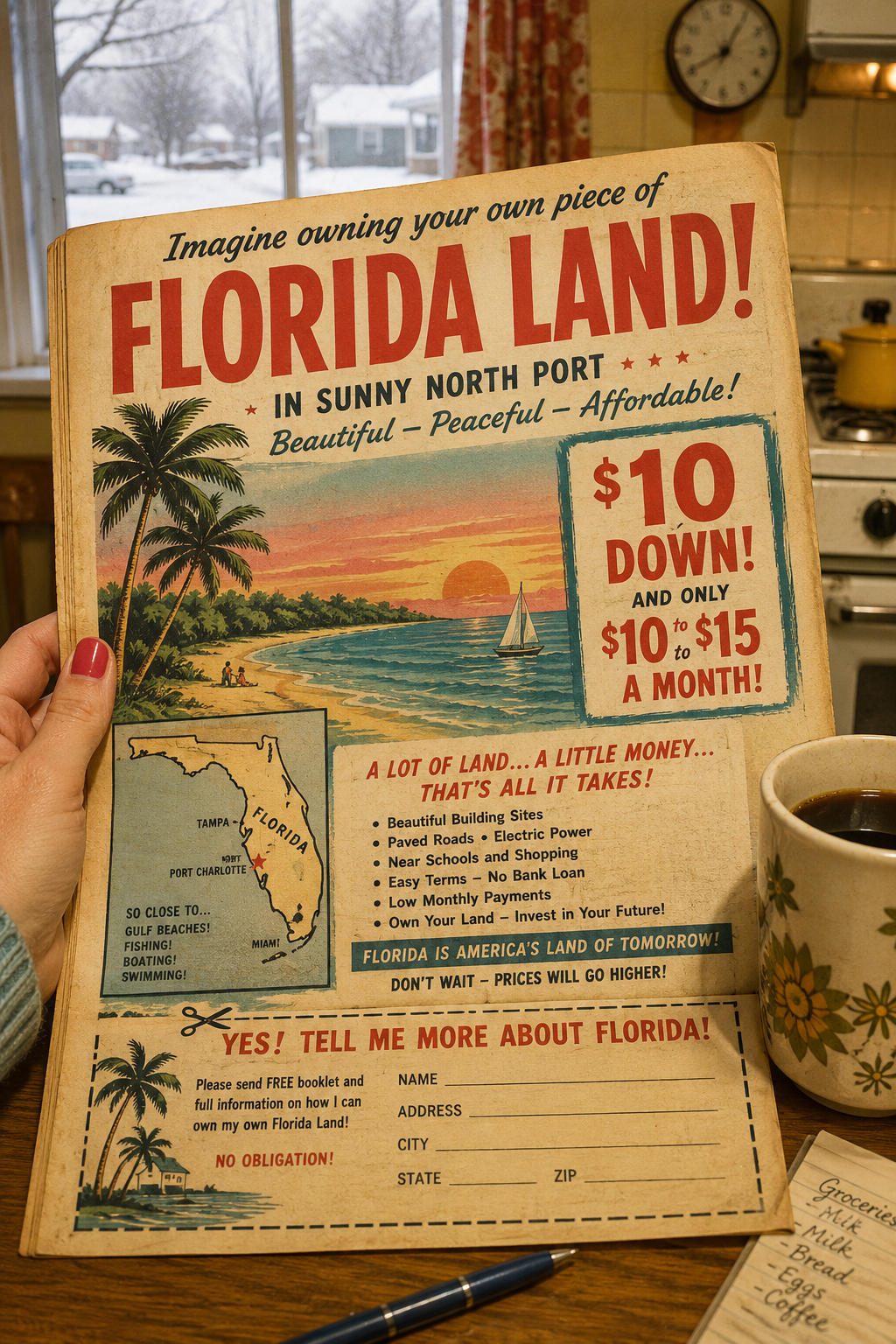
Historical Florida land advertisements weren't shy. They used oversized headlines, dramatic promises, tropical scenery and language about "paradise," sunshine and the future. Many emphasized that ordinary working people could afford to own Florida property through small installment payments.
The land itself might have been hundreds or thousands of miles away from the person reading the ad.
But the dream?
That fit right inside an envelope.
The Original "Buy Now, Pay Later"
Long before buying something in four payments became an internet checkout feature, Florida land developers had figured out the psychological power of a manageable monthly payment.
Some of the most famous campaigns advertised land for extraordinarily small amounts down.
The Mackle family's General Development Corporation, one of the major forces behind communities including Port Charlotte and North Port Charlotte, became particularly associated with this style of marketing.
The pitch was simple:
You didn't have to be wealthy to own Florida land.
You didn't necessarily have to move to Florida tomorrow, either.
You could buy a homesite now and hold onto it for the future.
That distinction mattered.
For someone sitting through another northern winter and imagining retirement 10 or 20 years away, buying a little piece of Florida made the dream feel tangible.
They didn't have the Florida house yet.
But they had the dirt underneath the future one.
And Yes...People Really Bought Land Through the Mail
This might be my favorite part.
Old land advertisements sometimes included an actual mail-in coupon.
Not:
Click here.
Not:
Schedule a Zoom call.
Not even:
Call our sales team.
More like:
✂️ CUT ALONG THIS LINE
Fill in your name.
Write your address.
Choose your payment.
Mail the coupon.
Some advertisements combined these response forms with maps, financing details and money-back guarantees designed to make buying property from hundreds of miles away feel less intimidating.
Which means somewhere in America, there was almost certainly a conversation that went something like:
"Honey, I bought us land in Florida."
"You WHAT?"
"It was in the newspaper."
Different times.
The Brochures Were Incredible
And by "incredible," we mean wonderfully, unapologetically Florida.
Think:
🌴 swaying palms
☀️ enormous sunsets
⛵ sailboats on sparkling lakes
🏖️ beaches
🗺️ maps showing your future community
🏡 happy people enjoying their new Florida life
The advertisements weren't merely showing acreage.
They were showing what your life might become.
Some developments were presented as cities of the future—places that were still largely undeveloped but were expected to grow as Florida's population expanded.
The message wasn't:
Here's some dirt.
It was:
Here's your place in the Florida of tomorrow.
And millions of Americans found that idea incredibly compelling.
So...What Happened to All That Land?
This is where the story gets really interesting.
Florida did grow.
A lot.
Some of those planned communities became major population centers.
Roads were built.
Homes went up.
Shopping centers arrived.
Schools opened.
People retired.
Children and grandchildren inherited properties.
But development didn't happen uniformly.
A subdivision could contain thousands of individually platted residential lots while houses were constructed gradually over decades.
Some owners built.
Some held their land.
Some sold it.
Some passed it down.
Some lost it due to unpaid taxes.
Some probably forgot about it for longer than they'd like to admit.
And that helps explain something you can still see in parts of Florida today:
House. House. Vacant lot. House. Vacant lot. Vacant lot. House.
The road exists.
The subdivision exists.
But the neighborhood is still filling in.
North Port Is a Fascinating Example
If you've spent any time looking at vacant land around North Port, you've probably noticed this pattern.
There are established homes.
Brand-new construction.
Wooded vacant lots.
And then another brand-new home.
All on the same road.
It can look strange until you understand the history.
North Port traces part of its development story to the enormous wave of planned Florida communities marketed during the postwar land boom.
What was once sold as future Florida has, over the decades, increasingly become present-day Florida.
And yet plenty of individual parcels remain vacant.
That's one reason the area is so fascinating to us as a land company.
You're not necessarily looking at some completely untouched place in the middle of nowhere.
In some areas, you're looking at a piece of a neighborhood that was imagined and divided into lots generations ago, and is still evolving today. In some cases, these areas are only just now evolving.
If you have ever been out to the North Yorkshire area of North port, you know exactly what I am talking about. And you can thank the Mackle brothers for that!
→ Read our North Port Land Guide
But There Was Another Side to the Florida Land Boom
The history wasn't all palm trees and happy retirees.
Florida's enormous land-selling era also produced excesses, questionable promises and, eventually, stronger consumer protections.
Some developments were marketed more enthusiastically than the reality on the ground justified. Buyers purchasing remotely didn't have anything close to the information available to buyers today.
Remember:
No Google Earth.
No instant flood-zone lookup.
No online zoning code.
No satellite imagery.
No clicking over to the county property appraiser.
A beautiful brochure could tell a very convincing story.
Actually verifying the property was another matter.
That history is one reason modern land buyers should appreciate just how much information they can access today.
Imagine Buying Land Without Google Maps
Seriously.
We sell land for a living, and this part is difficult to imagine.
Today, before purchasing a Florida lot, you can sit on your couch (probably with your pets) and investigate:
the parcel boundaries
surrounding development
road access
zoning
flood zones
wetlands indicators
nearby homes
county records
property taxes
utility availability
recent sales
You can zoom out.
Zoom in.
Look at aerial imagery.
Research county rules.
Then pull up driving directions and go see it yourself.
It’s a process that I am intimately familiar with. It is THE most important part of my job!
Someone buying Florida property through the mail in 1965 would probably think we have superpowers.
And yet...
The Funny Part Is That the Basic Dream Hasn't Changed Much
This is what we find most interesting.
Strip away the newspaper coupons and the wildly optimistic vintage advertisements, and people are still asking many of the same questions:
Could I own a little piece of Florida?
Could I build there someday?
Could this be somewhere I retire?
Could I leave it to my kids?
Could I afford the land now, even if I'm not ready to build yet?
That's remarkably similar to what those advertisements were selling generations ago.
The technology changed.
The due diligence got much better.
The prices definitely changed.
But the emotional appeal of owning a little piece of Florida?
That part survived.
And Owner Financing Didn't Disappear Either
There's another funny connection between then and now.
Installment payments were a huge part of the original Florida land boom because they opened ownership to people who couldn't, or didn't want to, write one giant check.
Owner financing still serves a similar purpose today.
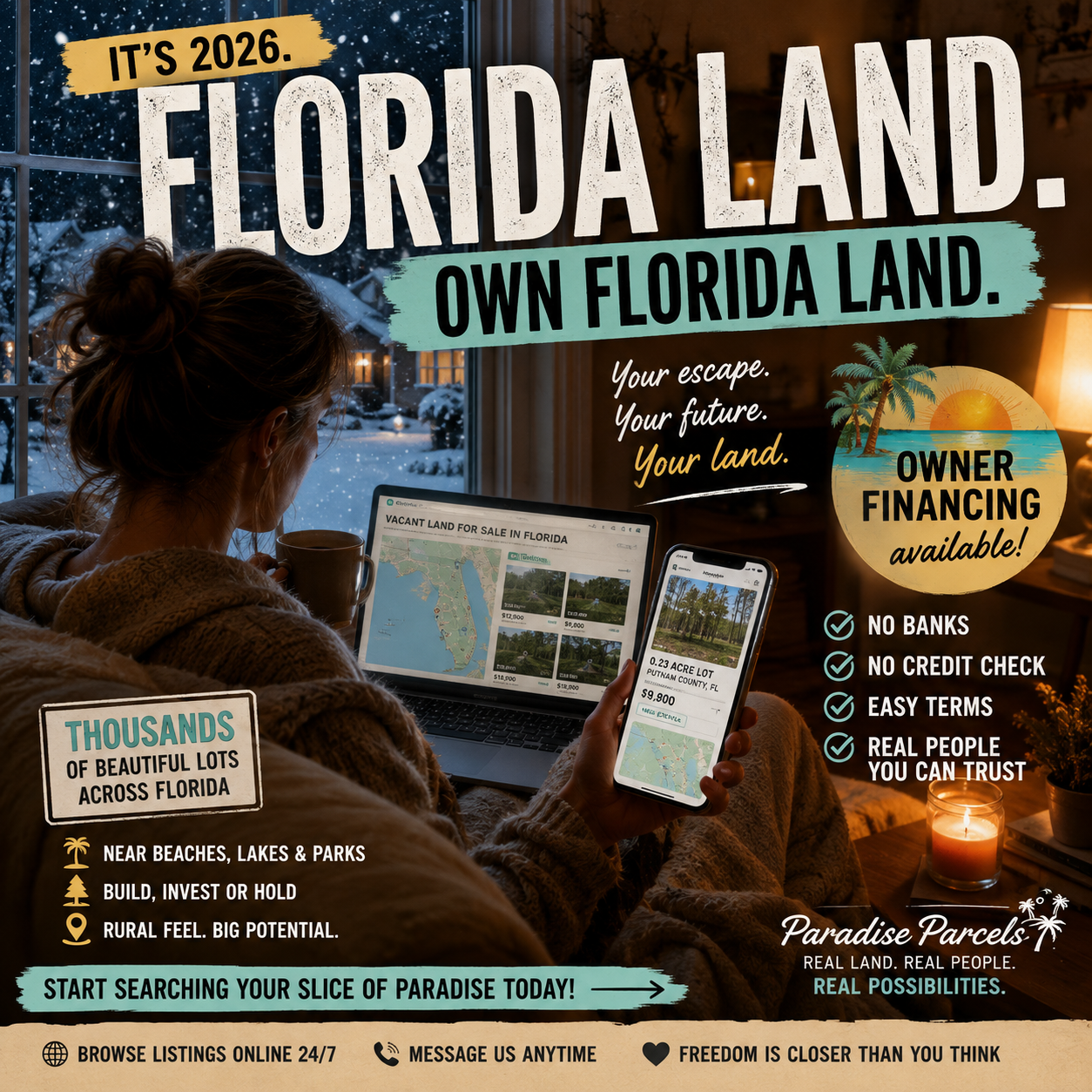
At Paradise Parcels, we offer owner financing on many of our properties, including options that don't require a traditional bank loan or credit check.
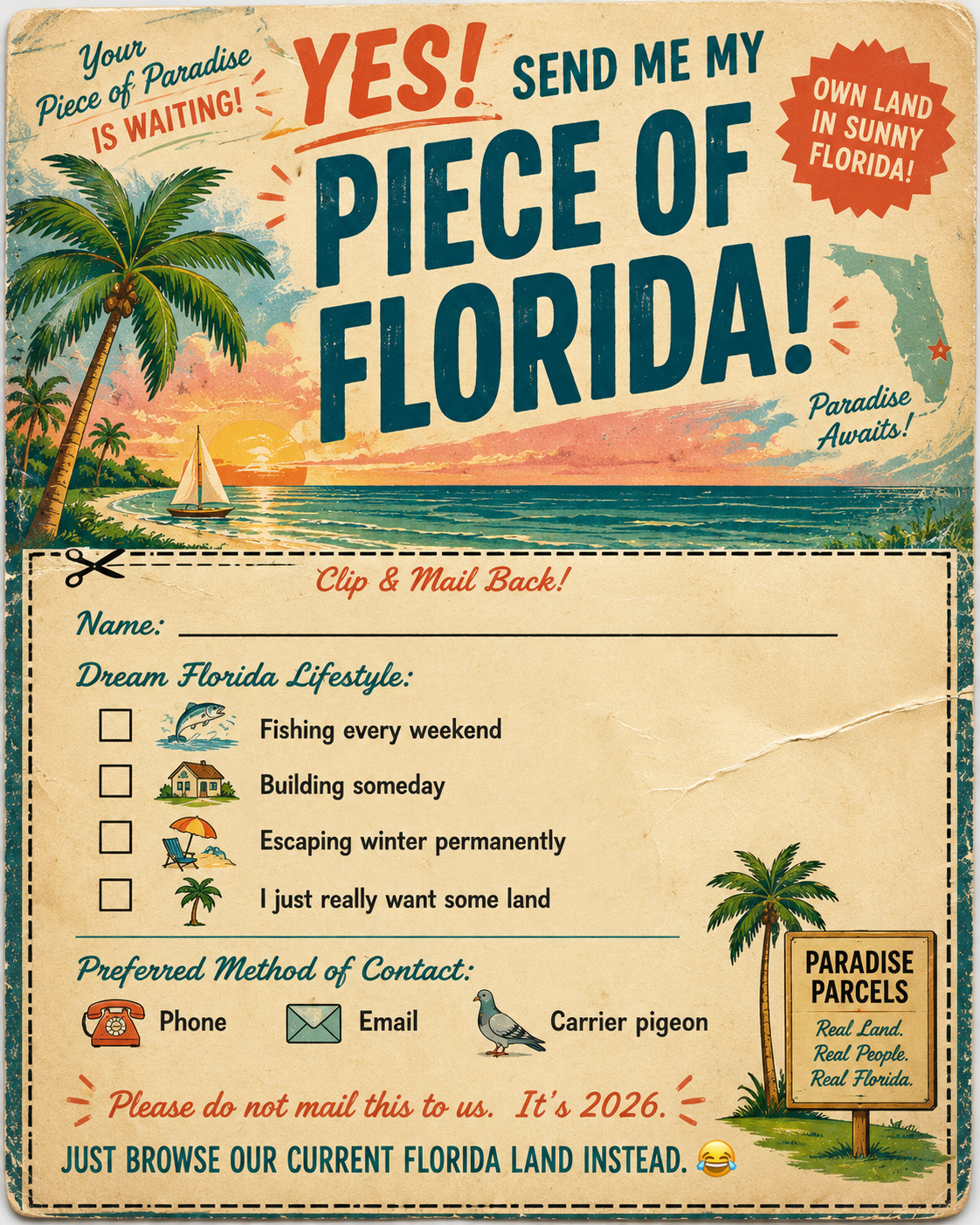
Obviously, we're not mailing you a newspaper coupon and asking for $10. 😂
But the basic philosophy is surprisingly familiar:
Buying land doesn't necessarily have to start with getting a mortgage from a bank.
→ How Does Owner Financing for Florida Land Work?
There's One Very Important Difference, Though
We think today's buyers should expect something those old brochures couldn't always provide:
information.
Pretty pictures are fun.
We love Florida sunsets as much as anybody.
But before buying land, you should understand what you're actually buying.
That means asking boring-but-important questions like:
Does it have legal access?
What's the zoning?
What can I actually do with it?
Is it in a flood zone?
Are wetlands present?
Will I need a well and septic system?
What does the surrounding area actually look like?
Those aren't nearly as romantic as:
🌴 YOUR PIECE OF PARADISE AWAITS! 🌴
But they're considerably more useful.
That's also why we've built an entire library of Florida land-buying guides.
→ Flood Zones & Wetlands: What Buyers Need to Know
→ Why Many Florida Lots Need Well & Septic
→ First-Time Florida Land Buyer's Guide
Would We Bring Back the Old Florida Land Ads?
Absolutely.
Just with significantly more disclaimers. 😂
There's something undeniably charming about them.
They were colorful.
Optimistic.
A little ridiculous.
And completely committed to selling the Florida dream.
Actually, maybe we should bring back the coupon.
The Florida Dream, 60 Years Later
Florida land has a strange history.
It's a story about sunshine and salesmanship, population growth and speculation, planned communities and retirees willing to buy a homesite they'd never actually seen.
Some of the promises in those old advertisements aged better than others.
But the central idea behind them proved surprisingly durable.
People wanted Florida.
And decades later, they still do.
Maybe that's why we love looking through these old advertisements so much.
Behind all the giant lettering and palm trees was a remarkably simple proposition:
Own a little piece of somewhere you love.
We can get behind that.
Just check the zoning first. 😉
Florida's Historic Land Boom
Did people really buy Florida land for $10 down?
Small down-payment and monthly-installment offers were genuinely used in Florida land advertising during the mid-20th-century land boom. Exact pricing and terms varied by development and promotion.
Why were there so many Florida land developments?
Developers anticipated continued migration and retirement-driven population growth and created enormous planned communities divided into individual residential lots.
Why are some of those lots still vacant today?
Being platted as a residential lot doesn't mean a home was immediately built. Individual parcels could remain undeveloped as owners held, resold or transferred them over generations.
Can you still buy inexpensive vacant land in Florida?
Yes, although prices vary enormously by county, location, zoning, utilities, access, size and buildability. Buyers should evaluate the individual property rather than judging it solely by price.
Can you still buy Florida land with monthly payments?
Yes. Some land sellers, including Paradise Parcels, offer owner financing that allows qualified properties to be purchased directly from the seller through installment payments rather than a traditional mortgage.