First-Time Land Buyer's Checklist: Everything You Need to Know Before Buying Florida Land
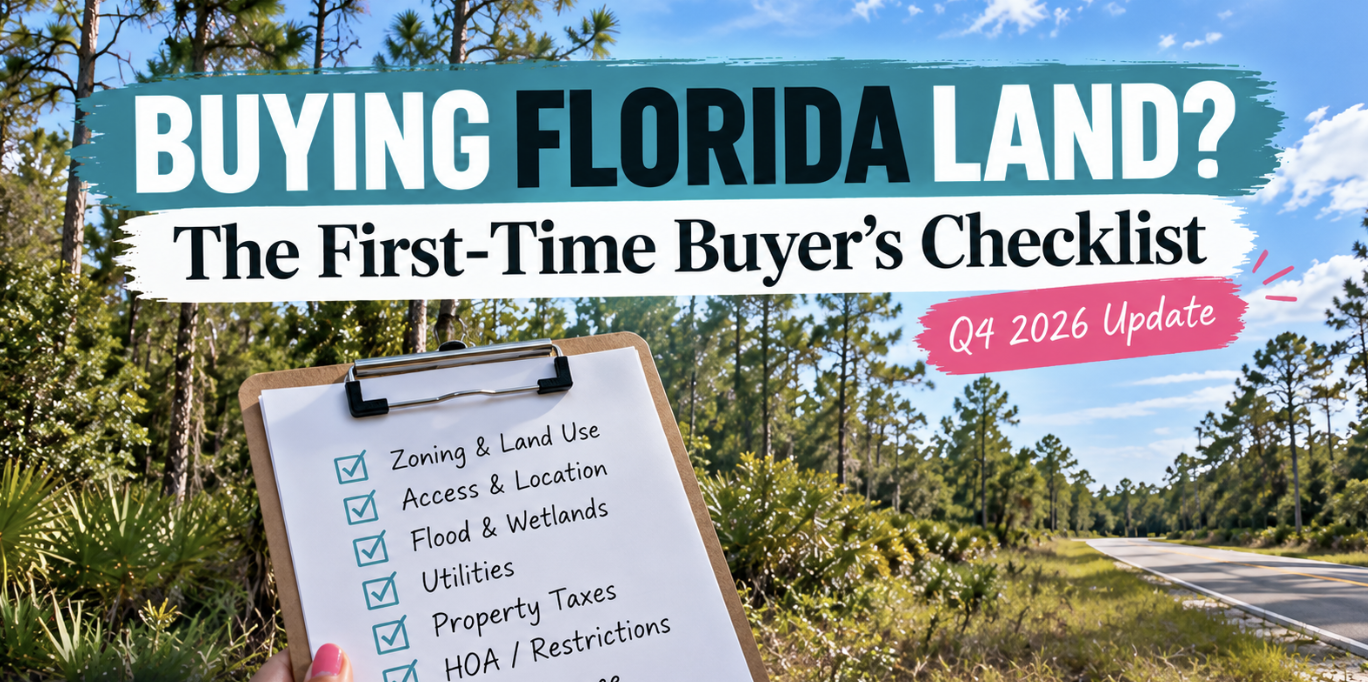
Q4 2026 Update
Buying your first piece of land is weirdly exciting.
It's also one of those purchases where you can spend three hours on Google and end up with more questions than you started with.
Can I build on it?
Can I put a manufactured home there?
What about an RV?
Does it have water?
What does "R-2" mean?
Why is this lot $10,000 and the one down the street is $30,000?
And what exactly am I supposed to check before I give someone money?
We've helped a lot of first-time land buyers at Paradise Parcels, so let's make this easier.
You don't need to become a surveyor, title examiner, zoning expert and septic contractor before buying land.
But you do need to know what you're buying.
Here's our Florida land-buying checklist.
1. Ask Yourself What You Actually Want to Do With the Land
Before looking at zoning maps or property records, answer this:
Why are you buying land?
Maybe you want to:
Build a house someday
Put a manufactured home on it
Hold it as an investment
Buy something now and figure out your plans later
Build a tiny home
Use an RV
Own some extra land next to property you already have
A property can be perfectly good land and still be completely wrong for your plans.
That's why one of the first questions we ask buyers is usually some version of:
"What are you hoping to do with it?"
2. Confirm Who Actually Owns the Property
Sounds obvious.. Check anyway.
Florida county property appraisers make ownership information relatively easy to research online.
Look up the parcel and compare the owner shown in the public record with whoever is trying to sell you the property.
If you're buying from Paradise Parcels, we're selling property we own rather than assigning you somebody else's purchase contract.
3. Find the Parcel ID
Florida vacant land doesn't always have a traditional street address.
That's normal.
One of the most useful pieces of information is the property's parcel identification number, sometimes called an APN, parcel number, property ID, or lot number.
Use that number when checking:
Property appraiser records
Tax records
GIS maps
Zoning
Flood information
Property boundaries
Deeds
4. Look at the Actual Property on a Map
Pull it up.
Look at:
Roads
Nearby houses
Vacant parcels
Businesses
Water
Power lines
Neighborhood layout
Surrounding development
Google Maps and aerial imagery are great starting points.
County GIS maps can give you additional information.
But remember that a map isn't a survey.
Online parcel lines are approximate and shouldn't be treated as exact property boundaries.
5. Check Access
Ask:
Which road, or roads serve(s) the property?
Is it paved, dirt or something else?
Is the road publicly maintained or private?
Does the parcel have legal access?
Is there an easement involved?
Physical access and legal access aren't always the same thing.
6. Check the Zoning
"What can I do with it?"
Start with zoning.
Depending on the county and municipality, zoning can affect things like:
Residential use
Manufactured or mobile homes
Minimum home sizes
Setbacks
Accessory structures
Animals
Commercial activities
RV use
Density
Zoning alone does not prove a property is buildable.
Seeing "Residential" on a property record isn't permission to build whatever you want.
7. When Possible, Check Future Land Use Too
Zoning and Future Land Use are related, but they aren't always the same thing.
Florida counties and municipalities use Comprehensive Plans and Future Land Use Maps to guide longer-term development.
If you're buying land with plans to develop it, it's worth understanding both the zoning and Future Land Use designation.
This becomes especially important when you're evaluating property near areas experiencing new development or land-use changes.
8. When Talking To The County, Verify Your Specific Intended Use
Don't ask:
"Can I build on it?"
That's too broad.
Ask:
"Can I build the specific thing I'm planning to build on this specific parcel?"
There's a big difference.
If you want a manufactured home, ask about a manufactured home.
If you want a tiny house, figure out exactly how that structure is legally classified.
If you want to live in an RV, ask about RV occupancy.
If you're planning a site-built home, ask what requirements apply to that.
If you know your plans, be as specific as possible. Get their answers in writing whenever possible.
Get specific.
And when your entire purchase depends on a particular use being allowed, verify it with the local Planning & Zoning or Development Services department BEFORE buying. Any reputable seller will encourage you to speak with the county before buying a property.
9. Check Flood Risk
Flood risk should be part of your due diligence.
FEMA's Flood Map Service Center is a good place to start. County GIS systems may also provide flood information.
But don't automatically treat every property in a mapped flood zone as unusable, or every property outside one as risk-free.
Flood zones affect properties differently.
If you're planning to build, find out what the designation means for your particular project, including potential elevation, permitting and insurance considerations.
10. Check Wetlands
Flood zones and wetlands are not the same thing.
A property can be outside a high-risk FEMA flood zone and still contain wetlands.
Florida buyers can use resources such as the U.S. Fish & Wildlife Service National Wetlands Inventory as an initial screening tool.
But mapped wetlands aren't the same thing as a professional wetland delineation.
If wetlands could materially affect your plans, get additional professional guidance before buying.
Don't let somebody tell you:
"It's not in a flood zone, so there aren't wetlands."
That's not how it works.
11. Figure Out Water and Sewer
Many affordable Florida vacant lots aren't connected to public water and sewer.
That doesn't automatically make them bad properties.
It may simply mean a future home would need a well and septic system.
Before buying for development, determine whether public utilities are available or whether well and septic would likely be required.
And don't assume that because the neighbor has a septic system, your property is automatically approved for one.
The individual site still matters.
12. Check Electricity
Power nearby doesn't necessarily mean electrical service is already installed on the lot.
Look for surrounding development and utility infrastructure, but contact the appropriate utility provider if electrical availability or connection cost matters to your plans.
For inexpensive vacant land, bringing utilities to a property can sometimes be a meaningful part of the total development cost.
13. Look at Property Taxes
Vacant-land property taxes in Florida can sometimes be surprisingly low.
But check the actual tax bill.
Look for:
Current annual taxes
Delinquent taxes
Special assessments
Whether the property is inside a municipality or special district
Also remember that today's tax bill isn't necessarily what you'll pay forever.
Property ownership, assessed value, development and other factors can change future taxes.
If you're financing land through Paradise Parcels, property taxes are generally collected on a prorated monthly basis according to your specific agreement.
14. Understand HOA and Deed Restrictions
Zoning isn't the only thing that can restrict land.
Some properties may also be subject to:
HOA rules
Recorded deed restrictions
Covenants
Easements
Plat restrictions
A county might allow something that a private restriction prohibits.,. Sometimes it can be difficult to tell if the lot is subject to HOA rules or deed restrictions. This can also mean that there are possible outstanding HOA fees which MAY transfer to the new owner. You shouldn't stop your research after finding the zoning.
15. Research the Title
Look for documents such as”
Mortgages
Liens
Judgments
Probate issues
Ownership problems
Easements
Recorded restrictions
Breaks or complications in the chain of title
Depending on the property and transaction, buyers may choose to use a title company and purchase title insurance.
For many straightforward properties, Paradise Parcels handles closing directly. For transactions involving more complicated title issues, probate or situations where a buyer requests it, we may use a title company.
16. Decide Whether You Need a Survey
Generally, you do not need a survey right away.
A survey can become especially important when:
You plan to build
Boundaries aren't obvious
Improvements are near property lines
Access is unclear
There's a possible encroachment
You're buying multiple adjoining parcels
Remember:
GIS parcel lines are not a substitute for a survey.
17. Calculate the Whole Cost
The purchase price isn't necessarily your total cost.
Depending on what you're buying and how you're buying it, consider:
Purchase price
Closing costs
Financing costs
Property taxes
Survey
Title work
Well
Septic
Utility connections
Clearing
Driveway
Permitting
Site preparation
A $10,000 lot isn't automatically cheaper than a $15,000 lot if the first one requires significantly more work to accomplish your goal.
18. Understand How You're Paying
You generally have a few options.
Cash
Cash is simple and usually gives you the lowest total purchase cost.
Paradise Parcels typically offers a discounted cash price on our properties.
Traditional financing
Banks and other lenders may offer financing for certain land purchases, although vacant-land lending can work differently from traditional home mortgages.
Owner financing
We offer owner financing on many Paradise Parcels properties.
Our standard plans don't require a credit check and don't have a prepayment penalty.
Instead of borrowing from a bank, you make the required down payment and agreed monthly payments directly under the financing arrangement.
The important thing isn't choosing whichever option sounds easiest.
Compare the total cost and terms.
19. Read the Contract
Please actually read it.
We know.
Contracts aren't exciting.
Read it anyway.
Understand:
Purchase price
Down payment
Monthly payment
Financing costs
Property taxes
Closing process
Default provisions
When you'll receive or record the deed
Restrictions while financing
Early payoff terms
Ask questions before signing if something doesn't make sense.
20. If You're Financing, Understand What You Can Do Before Payoff
Under our standard owner-financing arrangements, buyers generally cannot live on or build on the property while it's still being financed.
The property needs to be paid off first.
If you're planning to start construction immediately, that's something you need to factor into how you purchase the property.
21. Go See It If You Can
We love maps.
But there's still value in actually seeing a property.
When possible, drive by and look at:
Road condition
Surrounding homes
Drainage
Vegetation
Terrain
Neighborhood
Nearby development
For most of our properties, buyers can go look at the land on their own without scheduling an appointment with us.
We'll send you the location.
22. Don't Let a Cheap Price Rush You
Florida has plenty of inexpensive land.
Don't let:
"It's only $8,000!"
replace:
"Does this property actually work for me?"
There will be another piece of land.
The First-Time Florida Land Buyer's Checklist
Before buying, make sure you've considered:
☐ Parcel ID and ownership
☐ Location and surrounding area
☐ Legal and physical access
☐ Zoning
☐ Future Land Use
☐ Your specific intended use
☐ Flood information
☐ Wetlands
☐ Water and sewer
☐ Electricity
☐ Property taxes
☐ HOA or deed restrictions
☐ Title
☐ Survey needs
☐ Total development costs
☐ Purchase and financing terms
☐ Contract terms
☐ Property visit, when practical
And one final question:
Does this property make sense for what I actually want to do?
If the answer isn't clear yet, keep researching.
Frequently Asked Questions for First-Time Florida Land Buyers
Is buying vacant land complicated?
It doesn't have to be, but vacant land requires different due diligence than buying a house. There isn't a home inspection that conveniently answers everything. You'll need to investigate the land itself, its legal status and the rules governing how it can be used.
How do I know if Florida land is buildable?
There isn't one website that can definitively answer that for every Florida property. Zoning is only one part of the analysis. Access, lot status, setbacks, utilities, septic, floodplain, wetlands and other requirements can matter. If building is essential to your purchase, verify your specific project with the local jurisdiction before buying.
Can I put a mobile or manufactured home on vacant land in Florida?
It depends on the property. Rules vary by county, municipality and zoning district. Some areas allow manufactured homes and others don't. Always check the specific parcel.
Can I live in an RV on my Florida land?
Owning the property does not automatically give you the right to live in an RV on it. Florida counties and municipalities can regulate RV occupancy, and the rules vary considerably by location.
Do I need a lawyer to buy vacant land in Florida?
Not every Florida land transaction requires a buyer to hire an attorney. However, an attorney or title professional can be valuable when ownership, title, probate, easements, contracts or other legal issues are complicated.
Do I need title insurance?
Title insurance isn't automatically required in every cash land transaction. Whether you should purchase it depends on the property, title history, transaction and your risk tolerance. A title company or Florida real-estate attorney can explain what a policy would cover in your particular transaction.
Is owner financing good for first-time land buyers?
It can be useful for buyers who want to purchase land without traditional bank financing. Paradise Parcels offers owner financing on many properties without a credit check. Compare the complete cost and terms against your other options before deciding.
What's the biggest mistake first-time land buyers make?
Assuming.
Don't assume a residential lot is buildable.
Don't assume an R-2 lot allows your specific project.
Don't assume the road on Google Maps gives you legal access.
Don't assume a dry-looking aerial means there aren't wetlands.
And don't assume that because somebody nearby is doing something, you'll automatically be allowed to do it too.
Verify the things that matter to your plans.
You Don't Have to Know Everything Before Buying Land
If you've made it this far and you're thinking:
"Okay, now I'm even more nervous."
Don't be.
The point of this checklist isn't to make buying land scary.
It's to give you a process.
Start with what you want to do. Find a property you like. Work through the important questions one at a time. And when something matters enough that it could make or break your purchase, verify it with the appropriate county, municipality or professional.
That's how we approach land ourselves.
If you're looking for affordable Florida land, you can see our currently available properties at ParadiseParcels.com.
And yes, questions are encouraged.
Call or text us at 727-537-9537.
This Q4 2026 guide is for general educational purposes and isn't legal, financial, tax, surveying, environmental or land-use advice. Requirements vary by property and jurisdiction and can change. Verify important property-specific information before purchasing.