
Can You Build a Tiny Home on Vacant Land in Florida? Here’s the Honest Answer
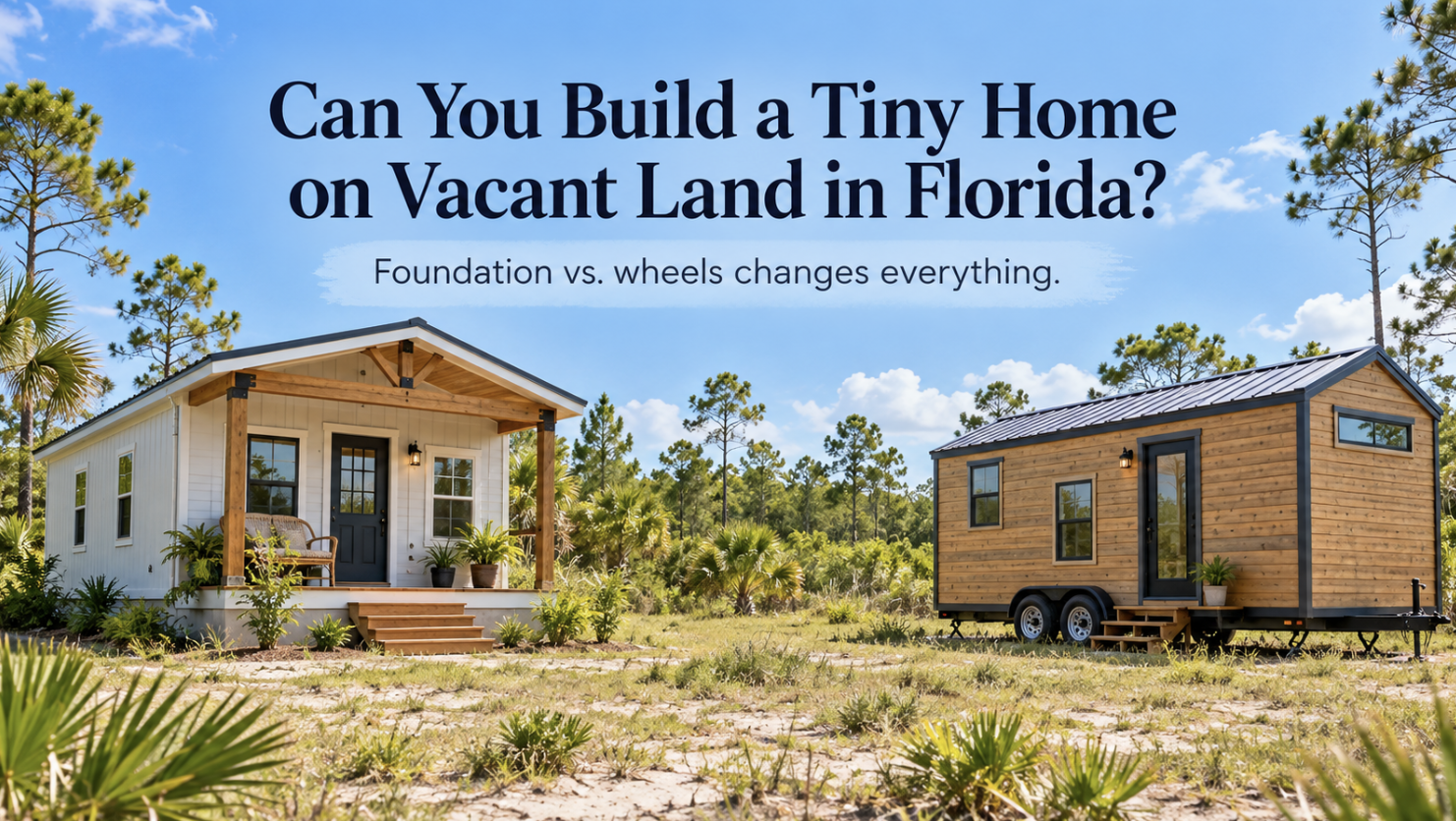
A little piece of Florida land, a tiny home, lower monthly expenses, and less stuff to deal with. We understand the appeal.
And yes, putting a tiny home on vacant land in Florida can be possible.
But this is one of those plans where you really want to check the rules before buying the land.
That’s because “tiny home” can mean very different things depending on how the home is built, whether it has wheels, where the property is located, and how the land is zoned.
First Question: Is the Tiny Home on a Foundation or on Wheels?
This is one of the biggest distinctions.
Tiny Home on a Permanent Foundation
A tiny home built on a permanent foundation is generally treated as a residential structure.
That usually means it needs to:
Meet applicable Florida Building Code requirements (including things like wind codes, minimum size builds, etc)
Be properly permitted
Meet setback requirements
Have approved water and wastewater systems
Comply with the zoning rules for that specific parcel
The tricky part is minimum dwelling size.
Depending on the county, municipality, subdivision, or zoning district, there may be minimum square-footage requirements for a residence. A very small tiny home may meet building-code requirements but still not qualify as an allowed residence on that particular property.
That’s why checking the exact parcel matters.
Tiny Home on Wheels
A tiny home on wheels, often called a THOW, is usually treated very differently.
Instead of being considered a conventional house, it may fall under RV or recreational vehicle rules.
That can affect:
Where it can be parked
Whether someone can live in it
How long it can stay on the property
Whether a permit is required
What type of water and sanitation setup is required
Some counties allow limited RV use under certain circumstances. Others are much more restrictive.
If your tiny home has wheels, start by researching the county’s RV rules rather than assuming the rules for a regular house will apply.
We also have a separate guide covering RV living rules in Florida.
Zoning Comes Before the Tiny Home
The tiny home itself is only half of the equation.
The other half is the land.
Every parcel has zoning rules that control what can be built or placed there.
Some residential zoning districts may allow smaller homes. Others may have minimum dwelling sizes or other requirements that effectively rule out a very small house.
Agricultural zoning does not automatically mean “anything goes” either.
Agricultural properties can still have rules covering:
Residential structures
Minimum home sizes
Setbacks
Accessory buildings
RV use
Septic systems
Number of dwellings
You also need to check whether the property is located inside a subdivision with deed restrictions or an HOA.
A county might allow a tiny home while private deed restrictions prohibit one.
Don’t Forget About Well, Septic, and Power
This is where the cheap-tiny-home dream can get more expensive.
A tiny home still needs basic infrastructure.
If the property does not have public water and sewer available, you may need a permitted well and septic system.
Those systems can require:
Soil or site evaluations
Septic permits
Well installation
Setbacks from property lines and other features
Enough usable space on the parcel for the required systems
You also need to figure out electricity.
Depending on the location and your setup, that could mean connecting to utility power or using an alternative system such as solar.
The important point is that a tiny home does not automatically mean tiny permitting costs.
The structure might be smaller, but many of the same development steps still apply.
What to Check Before Buying Land for a Tiny Home
Before buying a property specifically for a tiny home, we recommend doing these five things:
Get the parcel number.
You need the exact APN or parcel ID so the county can look up the correct property.Confirm the zoning.
Check the county property records and then verify the zoning with the planning or zoning department.Describe exactly what you want to do.
Don’t just ask, “Are tiny homes allowed?”Instead, ask something specific like:
“Can I place a 400-square-foot tiny home on a permanent foundation on this parcel?”
Or:
“Can I live in a tiny home on wheels on this parcel?”
Ask about water and wastewater.
Confirm whether a well and septic system would be allowed and what permits would be required.Check private restrictions.
Look for HOA rules, deed restrictions, subdivision covenants, or other private limitations.
Whenever possible, get the county’s answer in writing. If that isn’t possible, write down the department, the name of the person you spoke with, and the date.
For the rest of the due-diligence process, our Florida land-buying checklist covers the other things we recommend checking before purchasing vacant land.
So, Can You Build a Tiny Home on Florida Land?
Sometimes.
The important thing is not to buy a property first and figure out the rules later.
The answer can change based on:
County
City
Zoning
Square footage
Foundation type
RV classification
Septic requirements
HOA or deed restrictions
Two properties a few miles apart can have completely different rules.
If a tiny home is your goal, start with the land regulations and work backward from there.
That can save you from buying an inexpensive Florida lot that turns out to be completely wrong for what you wanted to do.
Frequently Asked Questions
Are tiny homes legal in Florida?
Tiny homes can be legal in Florida, but there is not one simple rule that applies to every parcel.
Whether one is allowed depends on the property’s location, zoning, building requirements, and whether the tiny home is built on a permanent foundation or on wheels.
Always verify the rules for the specific parcel before buying land for a tiny home.
What is the difference between a tiny home and an RV in Florida?
A tiny home built on a permanent foundation is generally treated as a residential structure and must meet applicable building and zoning requirements.
A tiny home on wheels may instead be treated as an RV or recreational vehicle.
That distinction can dramatically change where the unit can be placed and whether someone can legally live in it.
Can I put a tiny home on agricultural land in Florida?
Possibly.
Agricultural zoning does not automatically allow every type of residence. Agricultural zoning districts can still have rules covering dwellings, setbacks, minimum sizes, septic systems, and RV use.
Check the exact zoning classification and confirm your proposed use with the county.
Does a tiny home need a well and septic system?
If public water and sewer are not available, you will generally need an approved method for providing water and handling wastewater.
For many rural Florida properties, that means a well and septic system.
The exact requirements depend on the parcel and local permitting authorities.
Can I finance land for a future tiny home?
Yes. Paradise Parcels offers owner financing on many of our properties, with low down-payment options and no traditional bank financing required. But we do ask that you not live on or improve the property until it has been paid off.
But financing the land does not mean a tiny home is automatically allowed on it.
If a tiny home is your goal, tell us before you buy. We would much rather have you verify the county rules first than purchase a property that does not work for your plans.