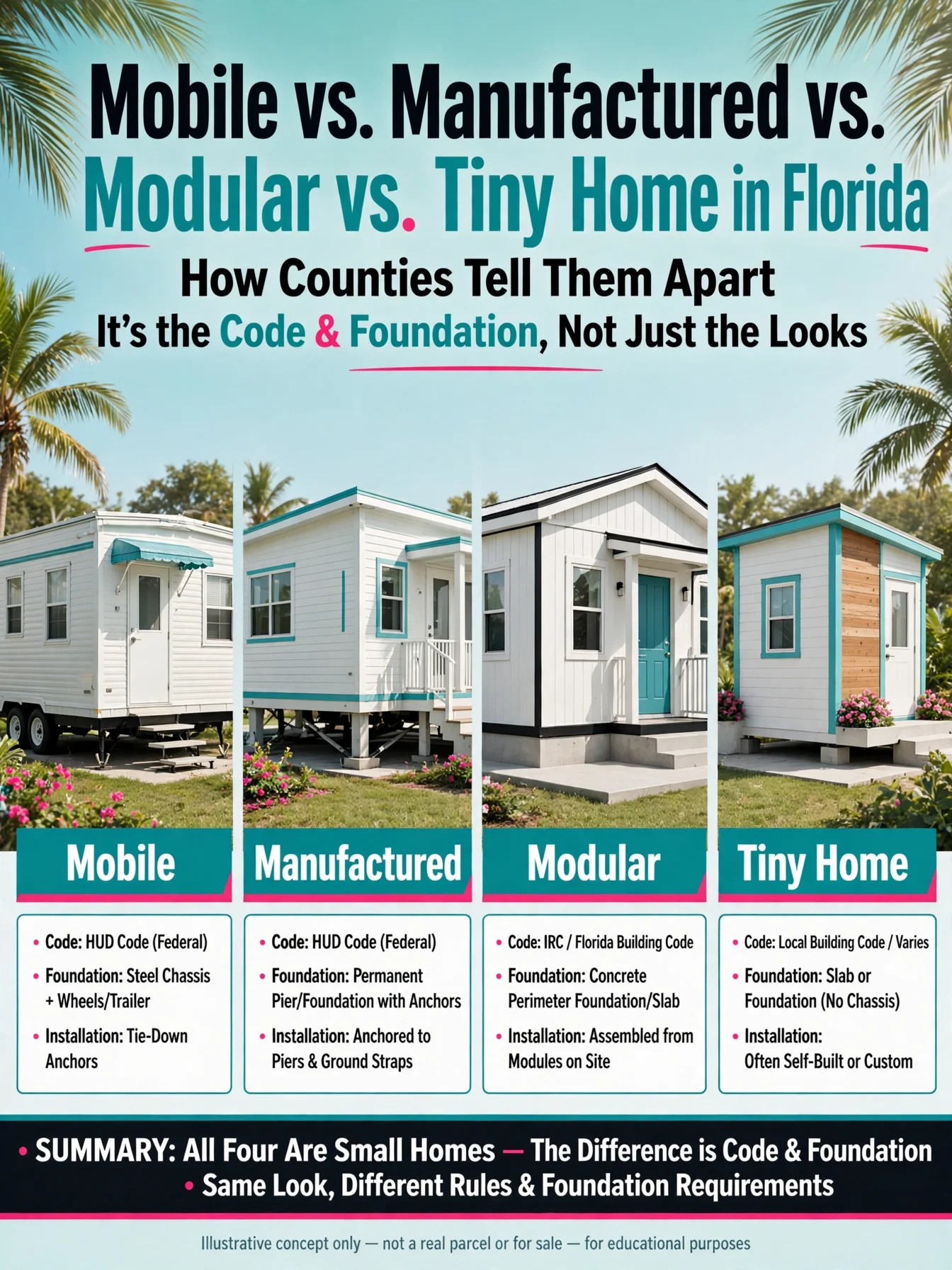
Sellers, builders, and buyers use these words like they mean the same thing. Florida counties do not.
A county does not decide by what a home looks like, or what the seller calls it. It decides by:
Which building code the home was built to
What label or approval it carries
Whether it sits on a permanent foundation or a chassis
What the zoning for that lot allows
Get one of those wrong, and you can buy a home you cannot legally place on the lot you bought. That is why this post starts with the labels, not the floor plans.
Mobile home: the older term
"Mobile home" is the older term for a factory-built home made before the federal HUD Code took effect on June 15, 1976.
In practice, that means:
Built before June 15, 1976, to pre-HUD standards
Built on a steel chassis, made to be moved
Usually not treated as ‘real property’ in the same way as a site-built home
Many people still say "mobile home" when they mean any factory-built home. Counties do not. If your home was built before 1976, say so early when you talk to the county, because the age alone changes how it is treated. Mobile homes do not follow proper wind codes, making them unsafe for the hurricane prone state of Florida.
Manufactured home: built to the federal HUD Code
A manufactured home is a factory-built home made on or after June 15, 1976, to the federal HUD Code; the National Manufactured Home Construction and Safety Standards.
(HUD stands for the U.S. Department of Housing and Urban Development)
In practice, that means:
Built in a factory, delivered in sections, on a permanent steel chassis
Carries a HUD label
Installed under Florida's manufactured-home installation rules, by a licensed installer
Anchored and tied down to meet Florida wind and installation requirements
A manufactured home is not the same as a modular home, even if they look alike from the street. The difference is the code: HUD Code for manufactured, Florida Building Code for modular. That code difference is what the county, the lender, and the insurer will ask about first.
Manufactured homes are commonly allowed in some zoning districts and in manufactured-home communities, and not allowed in others. A lot that allows a site-built home does not automatically allow a manufactured home. Check the zoning for that lot, not just the county in general.
Modular home: built to the Florida Building Code
A modular home is also built in a factory, but it is built to the Florida Building Code, the same code family that applies to a traditional site-built home.
In practice, that means:
Built in factory modules, delivered in sections, and assembled on site
Set on a permanent foundation designed for that home, such as poured footers, stem walls, or an engineered slab
No permanent steel chassis as its foundation
Permitted and inspected as building construction, not as a manufactured-home installation
Treated as real property once installed on its permanent foundation, in the same way as a site-built home
Because it meets the Florida Building Code, a modular home is generally treated much like a site-built home for financing and insurance, and it can often go on a residential lot that is not deed-restricted against it. Zoning, deed restrictions, and HOA rules can still limit it, so check those for the specific lot.
Tiny home: a size, not a separate code
"Tiny home" is not a single legal category in Florida. It is a size, and how the county treats it depends on how it is built and placed.
There are three common versions, and counties treat them very differently:
1. Tiny home on a permanent foundation
This is a small dwelling built to the Florida Building Code, generally 400 square feet or less in floor area, excluding lofts, under the code's tiny-house standards. The county treats it like any other house: it must meet zoning, setbacks, minimum lot size, utility, flood, and wind rules.
Florida sets no single statewide minimum house size for site-built homes. Counties set their own minimum dwelling sizes. That one number can decide whether a foundation tiny home is possible on a lot before anything else matters, so check it first for that county and zoning district.
2. Tiny house on wheels (THOW)
A tiny house on wheels is usually treated as a recreational vehicle in Florida, especially if it carries RVIA certification. That means it is generally legal to park and live in at an RV park or a licensed tiny-home community, but generally not as a primary home on a standard residential lot.
Parking a THOW on a lot is not the same as getting permission to live in it there. Storage is not residency. Do not buy a wheeled unit hoping the county will simply inspect it into a house. Most of the time they will not.
3. Park model
A park model is built to the ANSI A119.5 standard and stays under 400 square feet. In Florida it falls under manufactured-housing rules administered by the Department of Highway Safety and Motor Vehicles, rather than under a standard building permit. It is commonly placed in manufactured-home and RV communities, subject to tie-down and wind-zone requirements.
Same small size, three different legal paths. That is why "tiny home" alone is not enough information for a county office.
How counties actually tell them apart
When you call the county planning or building office, they will usually work through these questions in this order:
What code was it built to? HUD Code, Florida Building Code, RVIA, or ANSI A119.5?
What label does it carry? HUD label, state modular approval, or RVIA certification?
What is it sitting on? Permanent foundation, or a chassis with tie-downs?
Is it real property or personal property? A modular home on a permanent foundation is treated as real property. A manufactured home may be personal or real property depending on how it is installed and titled. A THOW is generally treated like a vehicle.
What does the zoning for this lot allow? A district may allow site-built and modular homes, manufactured homes, or neither. An accessory dwelling unit (ADU) rule is separate again — and an RV or mobile home is often explicitly not allowed as an ADU, even where a permanent foundation ADU is allowed.
What do the deed restrictions and HOA rules say? County approval does not override a private restriction on that lot.
Bring the answers to those six questions to the county, and you will get a useful answer. Bring only "it's a tiny home" or "it's a mobile home," and you will get a guess.
A note for Paradise Parcels buyers
Many of our lots are listed with notes about manufactured homes, and some allow manufactured homes while others do not. That note is for that lot only. It does not carry over to a different lot, even in the same county, and it does not mean RVs or tiny houses on wheels are allowed.
With owner financing, you cannot live on or develop the land until it is paid in full, even if the county would allow the home type. Financing approval and county approval are separate. You may start the process of getting county approval, but you cannot move anything onto the lot until your final payment is made.
Zoning can change, and a lot's current listing note is not a county approval. Confirm the current zoning for that lot with the county before you buy a home to place on it.
The bottom line
Do not shop by the name on the listing. Shop by the code, the label, and the foundation.
Mobile: pre-1976, pre-HUD, chassis.
Manufactured: post-1976, HUD Code, HUD label, chassis, licensed installation.
Modular: Florida Building Code, permanent foundation, treated as real property like a site-built home.
Tiny home: not a code by itself. Foundation tiny homes follow the building code. Tiny houses on wheels follow RV rules. Park models follow manufactured-housing rules.
If a seller cannot tell you which of those four your home is, in those terms, you do not have enough information to ask the county the right question yet.
FAQ
Is a manufactured home the same as a mobile home?
No. "Mobile home" generally means a factory-built home made before June 15, 1976. "Manufactured home" means one made after that date to the federal HUD Code.
Is a modular home the same as a manufactured home?
No. A modular home is built to the Florida Building Code and set on a permanent foundation. A manufactured home is built to the HUD Code and keeps a permanent steel chassis.
Can I put a tiny house on wheels on any lot I buy?
Generally, no. A tiny house on wheels is usually treated as a recreational vehicle, and full-time living in one is generally limited to RV parks and licensed communities, not standard residential lots.
Can I put a small home on a lot as an ADU?
It depends on the county and the lot. A permanent foundation ADU may be allowed where a wheeled unit is not. Check the ADU rules for that zoning district.
If a lot allows manufactured homes, does it allow RVs?
No. Those are separate permissions. A lot note about manufactured homes does not mean RVs or tiny houses on wheels are allowed.
Does county approval mean I can build right away on a financed lot?
No. With owner financing at Paradise Parcels, you cannot live on or develop the land until it is paid in full, even if the county would allow the home type.