
One question we get all the time from land buyers is:
“Wait... vacant land has property taxes too?”
On a lot of inexpensive vacant land in Florida, they really can be pretty low.
Many of the properties we sell have annual tax bills in the low hundreds. But that does not mean every vacant lot in Florida will have a tiny tax bill.
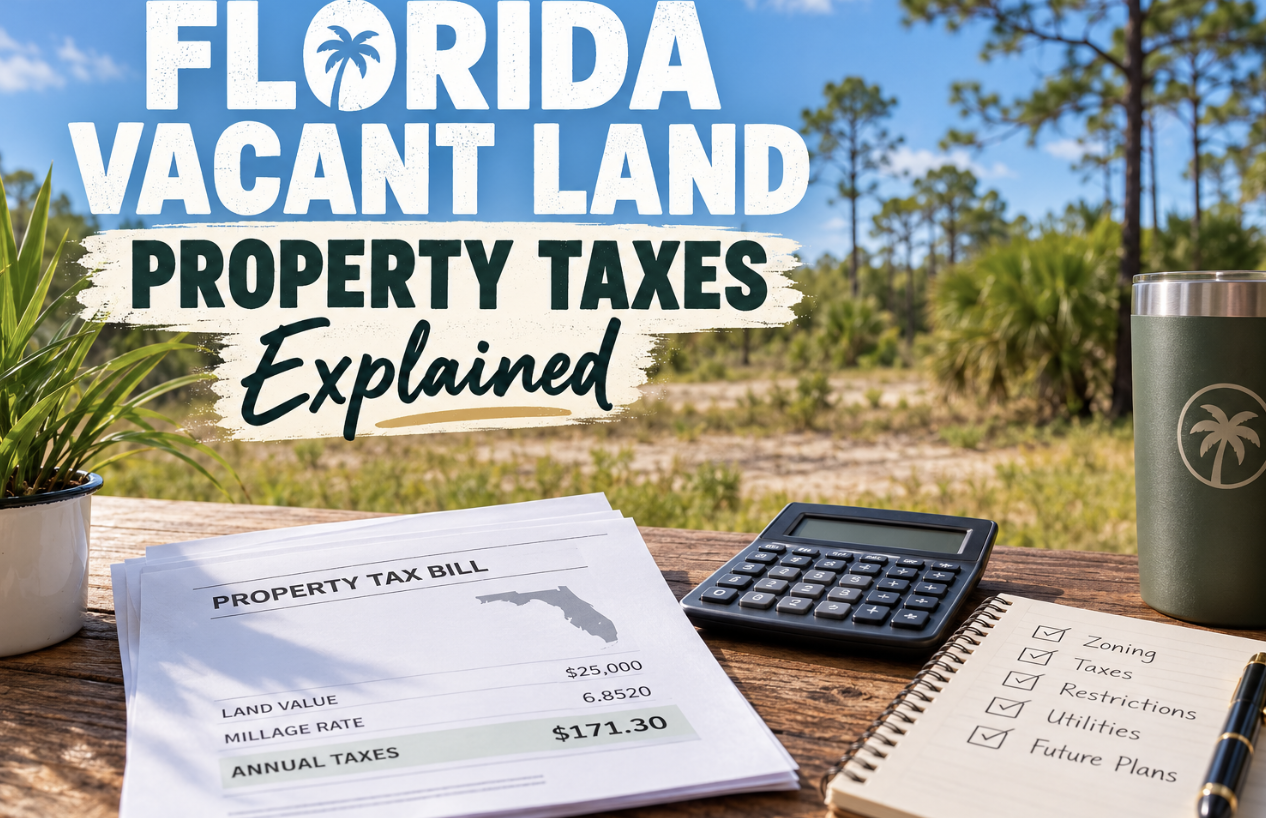
Property taxes depend on the value of the property, where it is located, which taxing districts apply, and whether the property qualifies for any special classification.
Here’s the basic version of how Florida vacant-land taxes work.
How Florida Property Taxes Are Calculated
Florida property taxes start with the county property appraiser.
Each year, the property appraiser determines the value of the property as of January 1. Florida then uses the property's taxable value along with the applicable local tax rates, usually expressed as millage rates, to calculate the ad valorem portion of the tax bill.
Those tax rates can include several different taxing authorities, such as:
The county
The school district
A city or municipality
Special taxing districts
That means two similar vacant lots can have different tax bills simply because they are located in different parts of Florida.
Vacant land also does not have a house or other major improvement adding to its value, which is one reason inexpensive lots often have relatively low annual taxes.
But we would never assume a property will be "$100 a year forever" based only on what the current owner is paying.
Assessments and tax rates can change.
What About the Homestead Exemption?
Florida's homestead exemption is tied to property that qualifies as someone's permanent residence.
For a typical standalone vacant lot that you buy and hold, you should not assume that you will receive a homestead exemption.
Florida law does allow homestead treatment to extend to certain contiguous real property associated with a qualifying residence, so saying that vacant land can never receive homestead treatment would be too broad. But if you're simply buying an empty parcel by itself, budget as though there is no homestead exemption unless the county property appraiser confirms otherwise.
That matters because the homestead exemption can reduce taxable value on qualifying residential property.
What Is Florida's Agricultural Classification?
You may also hear people refer to Florida's agricultural classification as Greenbelt.
This can significantly reduce the assessed value of qualifying agricultural land, but owning a rural parcel does not automatically make it agricultural.
Florida law requires the land to be used primarily for bona fide agricultural purposes, which the statute defines as good-faith commercial agricultural use. Property appraisers can consider things such as how long the land has been used that way, whether the use is continuous, the size of the property, agricultural practices being performed, and any agricultural lease.
In other words:
Buying five acres and mowing it occasionally does not automatically turn it into agricultural land for tax purposes.
Owners generally apply through the county property appraiser, with March 1 being the normal filing deadline for agricultural classification. Florida law also allows some counties to waive repeated annual applications after the classification has been granted.
If you're buying property that already has an agricultural classification, ask the county property appraiser what you will need to do after the ownership changes.
Don't simply assume the current tax treatment will continue.
When Are Florida Property Taxes Due?
Florida property taxes are generally due beginning November 1 for that tax year.
There is an incentive to pay early:
November: 4% discount
December: 3% discount
January: 2% discount
February: 1% discount
March: No discount
Property taxes generally become delinquent on April 1 of the following year.
So if you own a Florida lot and receive a tax bill in November, paying it sooner can save you a few dollars.
What Happens If Property Taxes Aren't Paid?
This is where Florida property taxes become much more serious.
If property taxes become delinquent, Florida uses a tax certificate system.
The county can sell a tax certificate covering the unpaid taxes, interest, costs, and charges. The tax certificate acts as a lien against the property.
The property owner can still redeem the certificate by paying the required amount.
But a tax certificate cannot sit unpaid forever.
Under Florida law, after the required statutory waiting period has passed, the certificate holder can apply for a tax deed. The current statute allows a certificate holder to apply after two years have elapsed since April 1 of the year the certificate was issued.
If the taxes and certificates are not redeemed before the tax-deed process is completed, the property can eventually be sold at a tax deed auction.
In plain English:
Ignoring the property tax bill long enough can eventually cost you the property.
That's one reason delinquent-tax research is an important part of vacant-land due diligence.
Does the Buyer Inherit Unpaid Property Taxes?
This is something you absolutely want to check before buying land.
Don't assume the amount shown on the most recent tax bill tells the whole story.
A parcel can have:
Current taxes
Delinquent taxes
Outstanding tax certificates
Non-ad valorem assessments
Other charges appearing on the tax bill
Before buying a property, check the county tax collector's records and make sure you understand what is outstanding.
When a title company is involved in the closing, these issues are generally addressed as part of the title and settlement process.
What Happens to Property Taxes at Closing?
On many Florida real-estate transactions, property taxes are prorated between the buyer and seller at closing.
Because the year's final tax bill may not have been issued yet, the closing statement may estimate the seller's share of the taxes through the closing date and assign the buyer's share from that point forward.
Exactly how the taxes are handled depends on the purchase agreement and closing structure, so check the settlement statement instead of assuming a particular split.
For our own properties, we make the tax treatment clear as part of the closing paperwork.
What If I’m Financing a Lot From Paradise Parcels?
If you’re buying a property from Paradise Parcels with owner financing, we make the property-tax piece pretty simple.
While you’re making payments, we typically collect a small monthly amount for property taxes along with your regular payment. That money is used toward the annual tax bill so you do not have to come up with the full amount all at once.
The exact amount depends on the property’s current tax bill and will be shown in your financing paperwork.
A few important things to know:
Property taxes can change from year to year.
Your monthly tax amount may need to be adjusted if the county changes the tax bill.
Paying off the property means you will take over responsibility for future property taxes directly.
Always check your agreement for the exact way taxes are handled on your specific purchase.
The goal is to keep it simple and predictable while you’re financing the land, rather than surprising you with a separate annual bill.
Don't Judge a Property Only by Last Year's Tax Bill
This may be the most important part of the whole article.
If a listing says:
Annual property taxes: $146
that tells you what the tax situation has recently looked like.
It does not guarantee that your future tax bill will be exactly $146.
A sale can affect assessments, taxing authorities can change millage rates, exemptions or classifications can change, and special assessments can appear.
We treat the existing tax bill as useful information, not a lifetime guarantee.
Before buying land, look up the parcel directly through the county property appraiser and tax collector.
Frequently Asked Questions
How are property taxes calculated on vacant land in Florida?
The county property appraiser establishes the property's value, and the applicable taxing authorities apply their millage rates to the property's taxable value.
The final bill depends on the property's value, location, exemptions or classifications, and the taxing districts that apply.
Are property taxes cheap on vacant land in Florida?
They can be.
Small, inexpensive vacant lots often have relatively low annual property taxes because there is no house or major improvement adding to the property's value.
But there is no statewide flat rate for vacant land, so always check the actual parcel.
Can I get a homestead exemption on an empty lot?
For a typical standalone vacant lot that is not your permanent residence, you generally should not expect a homestead exemption.
There can be situations where contiguous land is treated as part of a qualifying homestead, so ask the county property appraiser if your circumstances are unusual.
Can agricultural use lower my property taxes?
Potentially, yes.
Florida's agricultural classification can significantly affect the assessed value of qualifying land, but the property must be used primarily for bona fide commercial agricultural purposes and meet the county property appraiser's requirements.
What happens if I don't pay property taxes on Florida land?
Once taxes become delinquent, a tax certificate can be sold against the property.
If the certificate remains unpaid and the statutory waiting period passes, the certificate holder may eventually apply for a tax deed, which can lead to the property being sold at auction.
Are property taxes prorated when I buy vacant land?
They commonly are, but the exact treatment depends on the purchase agreement and closing.
Check the settlement or closing statement so you know exactly what portion is being charged or credited to each party.